At Dr. Barbara Samaroo’s The Healing Corner, this is a familiar pattern: people know they want support, but they do not yet know what type of support fits. Some want a private conversation first. Some want a hands-on session. Others are looking for a group format for caregivers, a church community, or a local discussion setting.
That is where a service-format map helps. Instead of treating every offering like a separate menu item, it helps to sort local wellness options by how the support is delivered and what kind of starting point makes the most sense.
Why local wellness seekers often need a clearer starting point
Many people search for Accokeek holistic wellness services when the real question is simpler: where should the process begin? A list of service names does not solve that problem. It often adds confusion, especially when the person is trying to choose between a conversation, an assessment, a body-based session, or a group format.
This shows up in local wellness decisions in a practical way. People are not always choosing between two known options. They are trying to match a need, a comfort level, and a setting. That is a different decision, and it usually gets harder when the service name drives the choice instead of the format.
A common pattern is starting too specifically. Someone sees reflexology, aromatherapy, or a workshop and tries to force a decision before knowing whether they want private support, educational support, or a shared discussion. The issue is not that the service itself is wrong. The issue is choosing too early, before the starting point is clear.
If that sounds familiar, How to Choose a Wellness Service: Assessments, Reflexology, Aromatherapy, and More breaks down that first decision in more detail.
A service-format map for holistic wellness in Accokeek and Prince George’s County
A practical way to understand Prince George’s County holistic wellness options is to group them by format. That makes it easier to see what each type of support is for and which one may fit best.
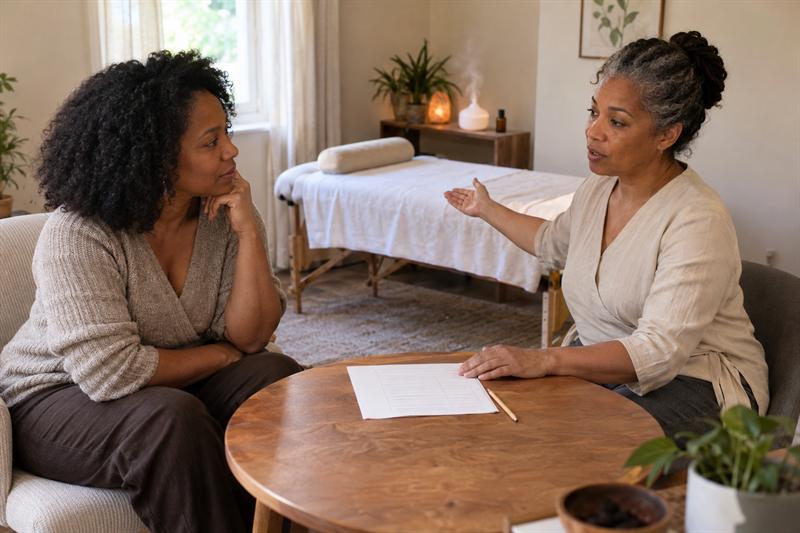
Consultations: when a conversation is the best first step
A consultation is often a good starting point when the main problem is uncertainty. The person wants support but does not yet know which service fits, what questions to ask, or whether they want a hands-on session at all.
This is one of the clearest decision points. If the issue is not knowing where to start, the best move is usually not to guess. It is to begin with a conversation that helps clarify goals, preferences, and comfort level. At Dr. Barbara Samaroo’s The Healing Corner, a free consultation can serve that role naturally by giving people room to sort through options before committing to a modality.
For readers comparing appointment styles, In-Person vs. Virtual Holistic Wellness Consultation: Which Format Fits Your Questions and Comfort Level? is a useful next step.
Assessments: when someone needs a more guided look at patterns and concerns
An assessment goes further than a basic conversation. It is a more guided format for people who want help organizing patterns, concerns, or questions before deciding what kind of support makes sense next.
This often fits people whose situation feels layered. They are not simply choosing between two services. They are trying to make sense of broader wellness questions and may need a more structured starting point. What often gets misunderstood is that assessments are not the same as casual exploration. They are generally better suited to situations where the person wants more context and direction than a simple introductory conversation can provide.
Body-based services: options for stress, tension, and physical reset
Body-based services are for people who know they want a session-centered experience with direct physical support. Reflexology is a clear example. It may fit readers who are less interested in a long discussion and more interested in a hands-on format.
Some people think more clearly once their body settles, while others need to talk first. That distinction matters. A body-based service usually works best when the person already knows they are comfortable with touch-based support and wants that style of experience.
Reflexology should not be treated like a catch-all answer. It is a format choice. That means it may fit some goals and preferences better than others, especially when the reader wants a direct session rather than a workshop or discussion format.
Sensory services: options centered on calming input and environment
Sensory services focus more on atmosphere, scent, and the feel of the experience itself. Aromatherapy and related options fit here because the support is shaped by calming input as much as by conversation.
This often appeals to people who want a lower-verbal experience or who pay close attention to comfort details such as scent, pressure, and temperature. A common pattern is overlooking sensory fit until after booking. That can leave the session feeling less supportive than expected because the choice was not made with comfort style in mind.
For a closer look at scent-based options, Questions to Ask Before an Essential-Oil Wellness Service: Aromatherapy and Raindrop Therapy helps clarify what to think through in advance.
Workshops: structured education for groups and organizations
Workshops are a different category entirely. They are designed for shared learning rather than for an individual appointment. That makes them a better fit for churches, community groups, caregivers, youth-facing organizations, and other settings where the goal is education in a group environment.
This is where many local readers make the wrong comparison. They compare a workshop to a one-on-one service as if both are trying to do the same job. They are not. A workshop often works best when the value comes from structure, shared learning, and a defined group topic.
Readers planning support for a group can explore Wellness Workshops for Community Groups, Caregivers, and Youth for more detail on how that format works.
Group discussion formats: community-centered wellness conversations
A group discussion format is more conversational than a workshop. It is generally better for shared reflection, real talk, and community exchange than for a formal teaching structure.
This often comes up in community-based wellness conversations. Some groups do not need a lesson plan first. They need space where people can process, listen, and speak honestly. That is why discussion-based formats work differently from workshops. The pacing, participation, and purpose are not the same.
If these signs sound familiar, a clearer next step is usually needed.
- You keep comparing service names but still do not know which format fits.
- You want support, but you are unsure whether you need a conversation, an assessment, or a hands-on session.
- You are choosing for a group and cannot tell whether a workshop or discussion format makes more sense.
- You have delayed booking because every option sounds possible and none sounds clearly right.
When that pattern shows up, the issue is usually not lack of interest. It is lack of a clear starting point.
Which local wellness option may fit different needs
The best local wellness option depends less on the label and more on the situation. The right choice usually becomes clearer once the reader knows whether the need is private, exploratory, or group-based.
For adults seeking one-on-one support
One-on-one support usually fits adults who want privacy, a more personal pace, or a format built around their own questions. This includes consultations, holistic wellness conversations, reflexology, and other individual services.
This often works best when the person wants space to focus without the dynamics of a group. It can also help when comfort, boundaries, or pacing matter enough that a private setting will lead to a better experience.
For people who are unsure what modality to choose
If the main issue is uncertainty, a consultation is usually a practical starting point. This is where many people get stuck. They think they need to pick the perfect modality first, when what they actually need is a better first conversation.
Choosing the right format first usually saves time and reduces frustration. It also helps prevent the common mistake of booking a service because the name sounds familiar, even though the experience itself is not the best fit.
Readers who want to compare local booking factors can review Accokeek Holistic Wellness Services: What to Look for Before Booking.
For caregivers, leaders, and community organizers
Caregivers, group leaders, and community organizers usually need to choose based on audience needs rather than personal preference alone. That changes the decision. A workshop may fit when the goal is shared learning. A discussion format may fit when the goal is conversation and connection.
This gets easier once the organizer asks one direct question: does the group need structure first, or space first? That distinction can quickly show whether a workshop or discussion format makes more sense.
How the core services fit within those formats
The core services at Dr. Barbara Samaroo’s The Healing Corner make more sense when they are placed inside the format map above. That is the difference between a scattered list of offerings and a decision guide people can actually use.
Holistic wellness and consultation-led support
Holistic wellness support often fits best as a broader path that starts with conversation and context. It may be useful when the person wants a wider view of support rather than jumping directly into one narrow service.
This may fit readers who are trying to understand the whole picture, not just book a single session. The main value is not speed. It is clarity.
Reflexology and other body-based wellness services
Reflexology fits squarely in the body-based category. It can be a strong option for people who want a more hands-on format and already know that a physical session experience suits them better than a discussion-only approach.
What usually matters most here is expectation. People often do best with reflexology when they choose it because they want body-centered support, not because they felt rushed into picking a named service.
Aromatherapy and raindrop therapy as sensory/body-centered options
Aromatherapy and raindrop therapy sit between sensory and body-centered support. They are helpful to compare together because the decision is not only about the service name. It is about whether the person wants scent-centered support, body-centered support, or a blend of both.
This is where comfort details become important. If scent sensitivity, pressure, temperature, or environment shape the experience, those factors should drive the choice. Ignoring them can lead to a mismatch between the service and the person receiving it.
Perception reframing as a mindset-support modality
Perception reframing belongs in a different lane from hands-on and sensory services. It is more reflective and perspective-centered. That can make it relevant for readers who are trying to shift how they interpret patterns, reactions, or internal narratives.
This is not the same kind of support as reflexology or aromatherapy. That distinction matters because some people are not looking for touch-based support at all. They may want a format centered on insight, meaning, and perspective rather than physical experience.
Yoni steaming and ionic foot detox within a broader wellness conversation
Yoni steaming and ionic foot detox are specialized offerings that often raise more questions than general wellness services. That is why context matters. These are not services people should choose just because the names sound interesting or unfamiliar.
This is where a guided conversation can help. When a service is more specialized or more personal in nature, the real question becomes whether it fits the person’s goals, comfort level, and preferred format. Without that context, people may choose from curiosity alone, and that can lead to more uncertainty instead of clarity.
Questions to ask before booking a local holistic wellness service
- What kind of support is actually needed: private, hands-on, educational, sensory-centered, or group-based?
- Is the main goal direct session support, a clearer starting point, or a group experience?
- Would a consultation help narrow the options before choosing a specific service?
- What setting feels most comfortable: one-on-one, workshop, or discussion group?
These questions matter because they shape the decision. A person who needs privacy should not choose based on what works for a group. A person who needs structure should not assume a discussion format will give enough direction. Better questions usually lead to better booking decisions.
Local next steps for wellness support in Accokeek and Prince George’s County
If the need is exploratory, start with a consultation. If the need is clearly session-based, choose the format that matches how support is best received. If the need involves a group, decide first whether the setting calls for structured teaching or open discussion.
At Dr. Barbara Samaroo’s The Healing Corner, the practical next step is not guessing between names. It is choosing the right format, then choosing the service inside that format. That approach can reduce hesitation and make the next step easier to act on.
Key Takeaways
- Local wellness decisions get clearer when services are organized by format, not just by name.
- Consultations often fit best when the main problem is uncertainty.
- Assessments may work better when the situation feels more layered and needs more structure.
- Body-based and sensory services may fit people who want session-centered support.
- Workshops and group discussions serve different community needs and should not be treated as the same format.
- The right starting point usually comes from matching the format to the need, not from choosing the most familiar service name.
Conclusion
The real problem is not lack of wellness options in Accokeek and Prince George’s County. The real problem is that people are often asked to choose too early, before they understand which format fits their need, comfort level, or setting. When that is not addressed well, hesitation grows, the wrong comparisons take over, and the next step stays unclear.
Dr. Barbara Samaroo’s The Healing Corner can be a practical next step because this kind of confusion usually needs guidance, not more guessing. When someone is deciding between consultation, assessment, hands-on support, or a group format, it helps to work with a provider who can sort the starting point clearly. That is why reaching out can make sense when the goal is to turn a broad local search into a direct, workable next step.
Company Approach
At Dr. Barbara Samaroo’s The Healing Corner, the approach is to help people understand what kind of support they are actually choosing. That sounds simple, but it is where many wellness decisions break down. People do not always need more options. They need a clearer way to sort them.
This is why the format matters so much. A consultation solves a different problem than a reflexology session. A workshop serves a different purpose than a live discussion group. When those differences are explained clearly, the decision usually becomes more manageable and more useful.
For readers ready to move from searching to deciding, Dr. Barbara Samaroo’s The Healing Corner offers a grounded local path forward that starts with clarity rather than pressure.
FAQ
What is the difference between a holistic wellness consultation and a wellness service session?
A holistic wellness consultation is the conversation stage. A wellness service session is the service stage. The consultation helps sort out what the person wants, what feels comfortable, and which format fits best. The session is the actual hands-on, sensory, or structured experience.
The distinction matters most when the person is unsure where to start. For example, someone may be interested in support but still not know whether reflexology, aromatherapy, or a discussion-based format makes sense. In that case, the consultation helps address the decision problem first.
Which holistic wellness option is best if someone is not sure where to start?
The most practical starting point is usually the format that reduces uncertainty first. That is why a consultation makes sense for many first-time readers. The main issue is not choosing the most appealing service name. The main issue is choosing the right kind of starting point.
What changes the decision is whether the person already knows how they want support delivered. If they do not know that yet, starting with a named modality often creates more confusion instead of less.
Are there holistic wellness options in Accokeek for community groups or caregivers?
Yes. Local holistic wellness options can include workshops and group discussion formats, not only one-on-one appointments. These often work best when the goal is shared learning, community reflection, or support designed around a group setting.
For example, a caregiver group may need structured teaching, while a community conversation may need a more open format. That difference matters because the audience is shaping the choice, not just the topic itself.
How do body-based services like reflexology fit into a broader wellness plan?
Body-based services like reflexology fit as one support format within a broader wellness plan. They are often the best fit for people who want a hands-on, session-centered experience rather than a conversation-led or group-led format.
A common misunderstanding is treating a body-based service like the entire plan. In practice, it is one type of support. The bigger decision is whether body-centered support is the right starting point for that person in the first place.
What questions should someone ask before booking a local holistic wellness service?
The most useful questions are about fit: What kind of support is needed? Does the person want private support, a hands-on experience, a sensory-centered service, or a group setting? Is the main issue uncertainty, planning for a group, or wanting a clearer path?
These questions matter because they move the decision away from service names alone. Two people can search for the same type of wellness support and still need completely different formats.
What is the difference between a wellness workshop and a group discussion format?
A wellness workshop is more structured. A group discussion format is more conversational. Workshops are built for guided teaching and shared learning. Group discussions are built for reflection, exchange, and community voice.
They should not be treated like two names for the same experience. The structure changes the outcome. If a group needs organized instruction, a workshop often fits better. If the group needs space to talk and process together, discussion is often the stronger format.