
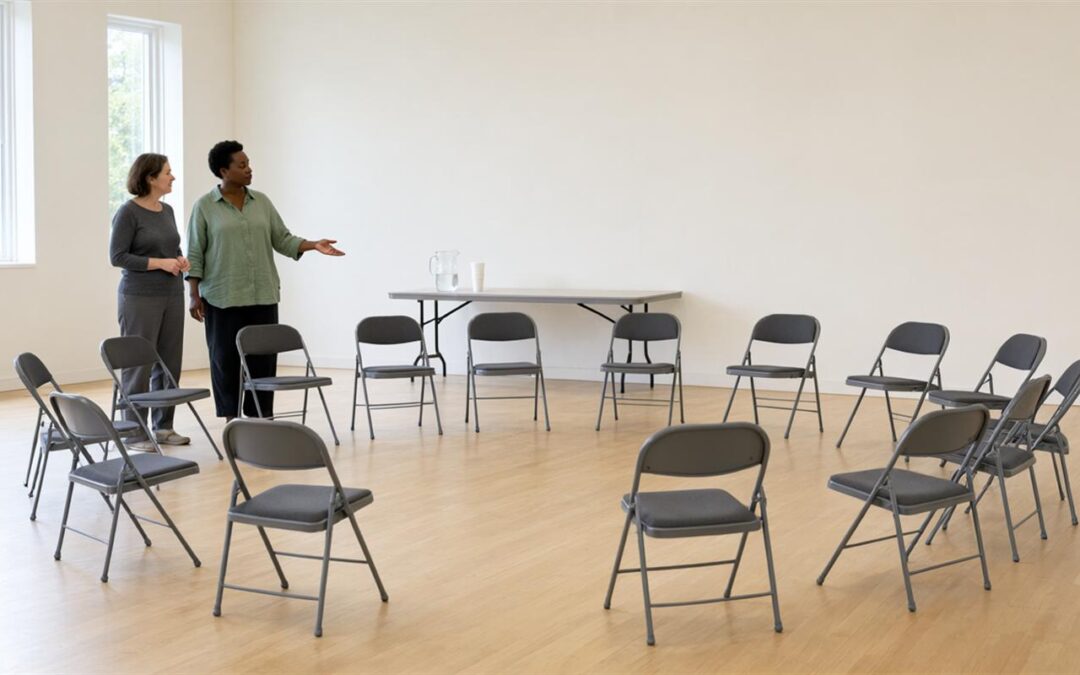
A group wellness session rarely goes wrong because the topic was wrong. It goes wrong because nobody asked, before the date was set, how an hour with eighteen people in a church hall would actually be handled. The room, the time and the budget get settled quickly. The facilitator is usually chosen from a description, and a description rarely answers the questions that decide the hour.
That is what the pre-booking conversation is for. It is not a courtesy call before a contract. It is where an organizer finds out whether the person leading the session has a plan for the room, a boundary around the subject, and an answer that holds up when the group turns out to be harder to hold than expected.
Why the Conversation Comes Before the Booking
A group wellness workshop is a 30- to 60-minute facilitated education session built around one specific audience need, not a general self-care lecture. The audiences differ more than the label suggests: caregiver groups, youth programs, senior activity centers, local nonprofits and work teams each ask something different of the person standing in front of them. The Healing Corner sets out that shape in its overview of wellness workshops for community groups, caregivers, and youth, where the duration and the one-need rule are stated plainly.
Thirty to sixty minutes is not much room for improvisation. A facilitator has to open the session, establish what the group is there for, keep the discussion from drifting, and close it before the room empties. That sequence is planned or it is not, and the organizer cannot tell which from a service list. Organizers who are still not sure a workshop is the right shape can compare a one-on-one consultation, a live discussion, and a workshop on what each format asks of the people in the room.
Questions About Scope and What the Session Is Not
Searches for “questions to ask wellness workshop facilitator” tend to return topic lists — stress, sleep, boundaries, nutrition — and the topic is the easy part. The harder questions are about edges: what the facilitator will cover, what falls outside the hour, and what happens when a participant asks something that belongs in a doctor’s office.
Start with the edge of the topic. What will this session cover, and what will it deliberately leave out? A facilitator who can name the boundary has thought about the room. One who offers to cover whatever the group raises has either not planned the hour or will not say so before the booking.
Then ask how a personal health question gets handled in front of the group. A participant may describe a symptom, a diagnosis, a medication or a family situation that no one in the room is positioned to answer. The useful response describes a route: the facilitator acknowledges the question, keeps the discussion general, and points the person to their own doctor for anything clinical. That is not a limitation to negotiate around. It is the boundary that keeps a wellness session from drifting into advice it should not be giving.
Group Wellness Session Questions About Facilitation
The practical questions about a group wellness session are rarely about the subject. They are about the room: who talks, who stays silent, and what happens in the awkward minute after someone shares more than expected. Ask these five before a date is fixed.
- What happens when one participant says nothing for the whole hour?
- How does the facilitator handle someone who talks over others, or answers every question first?
- What does the facilitator do when a disclosure lands in front of the group and the room goes quiet?
- If a participant asks to skip a topic or an activity, how is that handled without singling anyone out?
- What is planned for the last five minutes, when the questions people were holding tend to surface?
The answers matter more than the questions. A facilitator who describes a specific move — inviting a quiet participant by name, setting a talking order, closing a disclosure with a short redirect — is describing a plan. One who says the group will “flow naturally” is describing a hope. Group settings are unpredictable. Unpredictable is not the same as unplanned.
The prompts a facilitator will put to participants are a separate planning job, and a facilitation question bank for 30- to 60-minute community wellness sessions covers that side of the hour.
Questions About Preparation, Space, and Materials
Preparation questions are the ones organizers most often save for the week of the event, which is when they are least useful. Who supplies what. How the room should be arranged, and whether a circle of chairs is workable in the space available. What the facilitator needs from the organizer beforehand: a head count, the age range, a sense of what the group has already tried, and a contact who will be in the room.
Ask also who confirms the practical details on the day, and how. A session can be well planned and still start late because nobody agreed who unlocks the hall or where the sign-in table goes. These answers belong to the facilitator, and an organizer should hear them before the booking rather than on arrival.
Questions About Background and Approach
Ask what the facilitator has actually run before, and ask for the shape of it rather than a title. A description like “caregiver groups of about twenty, mostly weekday mornings” tells an organizer more than a list of certificates read aloud. Then ask how the facilitator would describe their own training, in their own words, and what they do when a topic turns out to sit outside it.
The second answer is the more useful one. Every facilitator meets a question they cannot answer well, and what happens next separates a careful practitioner from an optimistic one. A facilitator who says plainly that a topic falls outside their training, and describes where they would send the group instead, has given the organizer a working boundary. That is more reassuring than a claim that nothing falls outside the scope.
How to Vet a Community Wellness Facilitator: Reading the Answers
Vetting is less about the questions than about what comes back. A specific answer names what the facilitator would do. A vague answer describes how the session will feel. “It will be a calm, welcoming space” is not an answer to “how do you handle a participant who dominates the conversation,” and the difference is usually audible within the first few minutes of the call.
Listen, too, for the answer that opens with a condition. A facilitator who says that depends on the group, and then explains what it depends on — size, setting, whether the participants already know each other, how the topic was introduced — is showing the organizer how a plan gets built. Someone who agrees to every request is showing the opposite: willingness in place of a method.
One habit makes the comparison honest. Put the same three questions to every facilitator under consideration, in the same order, and write the answers down while the call is fresh. Two or three conversations are usually enough to show whether the difference between candidates is style or substance, and a written record keeps the decision from resting on whichever conversation happened most recently.
Logistics, Cost, and What Happens After
The last group of questions is the one organizers can settle on their own: what the fee covers, what the group is expected to provide, and what the facilitator sends afterward. A follow-up handout, a short summary for the organizer or a list of resources all change what the group takes home, so it is worth knowing which one is coming before the session rather than after it.
Timing belongs here as well. At The Healing Corner, sessions are booked one at a time, and weekday appointments run 8 AM to 5 PM Eastern, with Saturday and Sunday closed. Group organizers can ask about a group session before committing to a date, which leaves room to check availability against the group’s own calendar instead of working backward from a fixed date.
Key Takeaways
The interview itself is short, and most of it is spent listening. What an organizer is testing is whether the answers change when the questions get harder.
- Test the plan against the room: quiet participants, dominant talkers, and a disclosure in front of everyone.
- Prefer an answer that describes a process over one that describes a feeling.
- “That depends” is useful when the facilitator then explains what it depends on.
- Confirm scope, space, fee and follow-up before a date is fixed, since those details decide how the hour runs.
Conclusion: Start With the Group You Are Bringing
Dr. Barbara Samaroo and The Healing Corner run group wellness sessions in Accokeek and across Prince George’s County, Maryland, from 2911 St Marys View Rd, Accokeek, MD 20607. The hands-on services — Reflexology, Ionic Foot Detox, Aromatherapy, Raindrop Therapy, Yoni Steaming, Holistic Medicine, Perception Reframing, Holistic Iridology and Zyto Select Balance — sit alongside the group format, so an organizer can ask about a session and about the services in one conversation. A free consultation comes before any booking, and it is the right place to bring the questions above, with the group’s real shape described, before a date is chosen.